What is Ownership Debt? Why founder-led brands slow down after senior hires (2026)
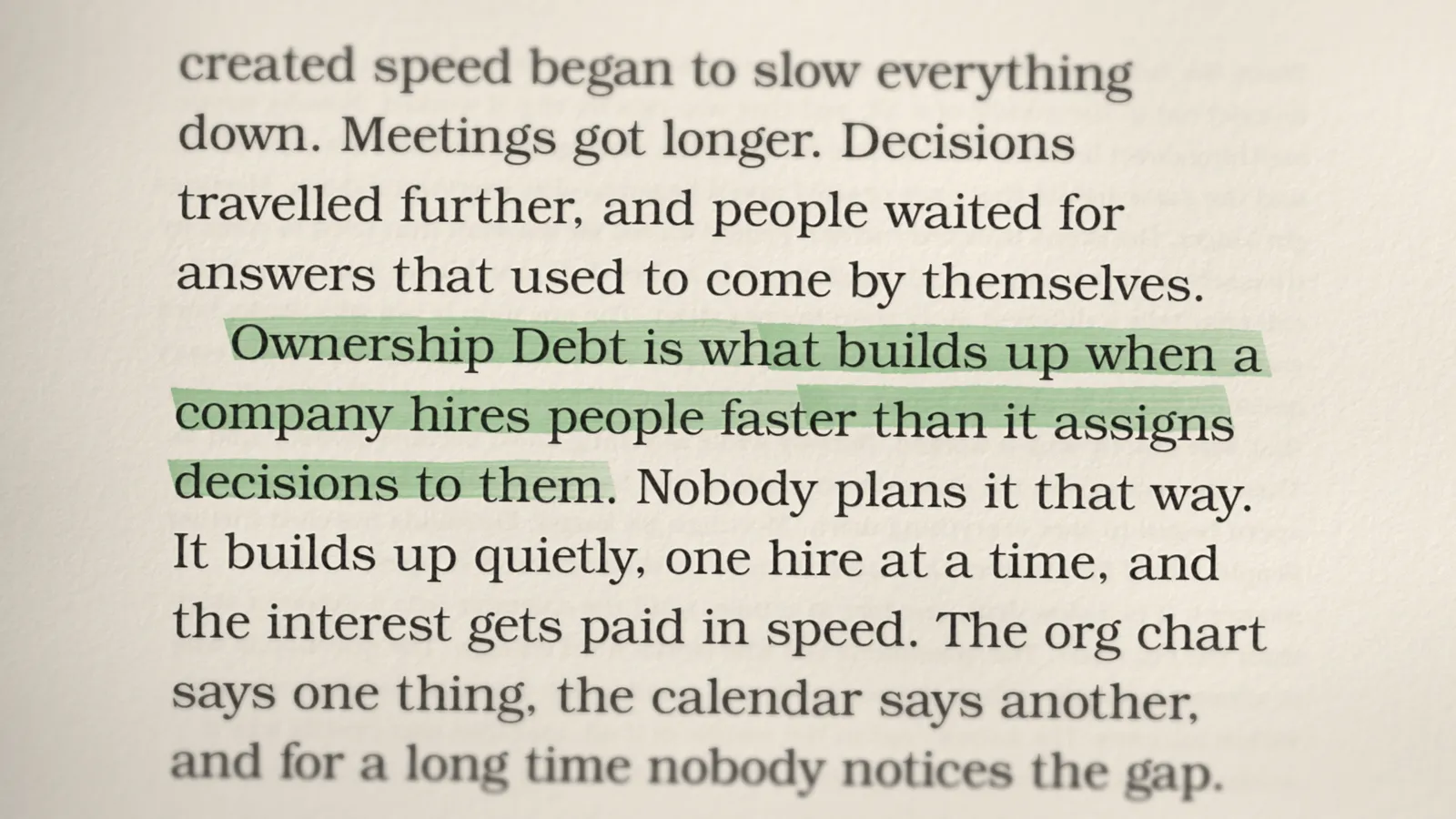
Ownership Debt is what builds up when a company hires people faster than it assigns decisions to them.
You can see it in many founder-led E-Commerce brands that grow past the eight-figure mark. The team doubles. The org chart starts to look grown-up. And yet the important decisions still end up on the founder’s desk, usually on a Friday afternoon.
Nobody planned it that way. That’s exactly what makes it a debt: it builds up quietly, one hire at a time, and the interest gets paid in speed.
Definition: Ownership Debt is an organizational gap in growing companies. Headcount, tasks and teams grow, but explicit decision rights do not. It is not a lack of responsibility: employees carry out the work, while final decisions remain with the founder. Typical results are slower decisions, a founder bottleneck and senior hires who cannot fully act in their role.
How does Ownership Debt build up?
Ownership Debt builds up when a founder hires senior people to take load off, but hands over tasks, teams and budgets without an explicit list of decision rights. The new hire takes on responsibility, while the final say stays with the founder. Every senior hire made this way adds capacity on paper and one more person waiting for a decision in practice.
In 2026, many fast-growing brands don’t have a hiring problem. They have a handover problem.
The sequence is usually the same:
- The business gets more complex: new channels, new markets, more SKUs, more people.
- The founder hires someone senior to take load off. A Head of Operations, a Head of Marketing, a first COO.
- The new person gets tasks, a team and a budget. What they rarely get is a clear list of decisions that are now theirs.
- So they do what smart people do: they ask good questions. And the answers still come from the founder.
Three months later, the founder is still in every meeting that matters. Not because the hire was wrong. Because the work was handed over, but the decisions weren’t. This is why so many first senior hires look like they “didn’t work out”, when the role was never really given decision rights.
That’s the distinction that matters:
- Responsibility means doing the work.
- Ownership means deciding, and living with the outcome.
A company can add responsibility endlessly. Ownership has to be given away on purpose.
What are the signs of Ownership Debt?
The clearest sign of Ownership Debt is a founder whose calendar gets fuller, not lighter, after senior hires. Other signs: leaders bring options instead of decisions, the same topics return to every weekly meeting, two people claim the same responsibility, and decisions wait whenever the founder is away. Five patterns to check:
- Your senior hires bring you options instead of decisions.
- The same topic comes back in the weekly meeting for the third time.
- Two people believe they own the same thing. Or nobody does.
- Your calendar got fuller after the last senior hire, not lighter.
- When you’re on holiday, decisions wait instead of being made.
If three or more sound familiar, the problem is rarely the people. It’s that the company’s operating system still assumes the founder decides. That is what turns a founder into the bottleneck.
Why do founders miss Ownership Debt, and what does it cost?
Founders miss Ownership Debt because the setup that creates it once worked: in the early years, one person deciding everything was the fastest way to move. The cost appears later and spreads out: slower decisions, frustrated senior hires and a company whose value depends on its founder being in the room.
Founders don’t create Ownership Debt out of ego. Usually it’s the opposite: one head, one calendar, short paths. It worked.
The problem is that this setup never gets an official update. The business grows, the team grows, but the unwritten rule stays: when in doubt, ask the founder.
The cost shows up in four places:
- Speed: decisions queue up behind one calendar. In a McKinsey survey of 1,259 executives and managers, respondents spent 37% of their working time on decisions, and 61% said most of that time was used ineffectively.
- People: strong hires get frustrated when they’re hired to lead and then asked to wait. They’re often the first to leave.
- Results: Bain research across nearly 800 companies found that decision effectiveness and financial results correlate at a 95% confidence level or higher.
- Value: Henrik Sabban, board member at Good Brands AG, put it this way at NEWCOM Summit 2026: a buyer wants a company that grows, makes decisions fast, is run professionally and keeps running normally if the founder walks out tomorrow. That is what a buyer pays more for.
Scaling Glow25 from €7M to €130M, bootstrapped, I saw how fast this builds up, and what it takes to keep updating who decides what while the company keeps growing.
How do you pay down Ownership Debt?
You pay down Ownership Debt decision by decision, not with a new org chart. Take the ten decisions that land on the founder’s desk most often and assign each one explicit decision rights: one person who decides, the people heard before, the people informed after. Then review those decision rights every quarter as the business grows.
For each of those ten decisions, answer three questions:
- Who decides? One name, not a team.
- Who needs to be heard before? Only the people whose input can change the outcome.
- Who needs to know after? Everyone else who’s affected.
Then write it down and make it visible. Not in a slide nobody opens, but where the team actually works. It pays off: in the same McKinsey survey, organizations that make decisions at the right level, often by delegating them downward, were 6.8 times more likely to be among the best decision makers.
Two rules make it stick:
- Hand it back. When someone brings you a decision that now belongs to them, give it back. Every time, especially in the first weeks.
- Review it every quarter. Your business keeps getting more complex, so who decides what has to keep up. A one-time cleanup only sets you up for the next round of debt.
FAQ
Is Ownership Debt the same as micromanagement?
No. Micromanagement is a behavior: a leader controls how work gets done. Ownership Debt is a structural gap: decision rights were never formally handed over. A founder can avoid micromanaging and still carry Ownership Debt, because people simply don’t know which decisions are theirs to make.
When does Ownership Debt typically appear?
Ownership Debt typically appears with the first senior hires and the first management layer, when the founder can no longer be close to every decision. In E-Commerce, new channels, markets and SKUs often speed it up, because business complexity grows faster than the organization updates who decides what.
How is Ownership Debt different from an accountability chart (EOS)?
An accountability chart assigns seats and responsibilities per role. Ownership Debt often sits between roles: in decisions that touch several teams, such as pricing, launches or inventory. Clear seats help, but paying down Ownership Debt also needs explicit rights for cross-team decisions and a rhythm to update them.
Do we need a COO to fix Ownership Debt?
Not necessarily. A COO adds senior capacity, but if decision rights stay unclear, the COO becomes one more person waiting for the founder. Clarify who decides what first. Then a COO, if you still need one, joins a structure that works instead of inheriting the debt.
How long does it take to pay down Ownership Debt?
In my experience, first relief comes within weeks, once the ten most frequent founder decisions have clear owners. Making it stick takes longer, usually one to two quarters, because the team needs to trust the new decision rights and the founder needs to stop taking decisions back.
The bottom line
Hiring adds capacity. Only ownership adds speed.
If your team has grown and your calendar hasn’t gotten lighter, you’re probably not short of people. You’re carrying Ownership Debt.
Finding and closing exactly this kind of Gap is what Structural Scale™ is built for. If you want to see where yours sits, the free Scale Readiness Review takes 7 minutes.
Sources
- McKinsey & Company: Decision making in the age of urgency, April 2019 (survey of 1,259 participants, February 2018)
- Bain & Company: Decision Insights: Score your organization, October 2010 (survey of nearly 800 companies)
- Henrik Sabban (Good Brands AG) and Jan-Lütje Thoden (Start To Finish): “Hiring for Scale”, NEWCOM Summit, Munich, October 21, 2026 (talk in German, paraphrased and translated by the author)

About the author
Patrick Grossmann is the founder of Structural Scale and a strategic advisor for fast-growing, founder-led E-Commerce and omnichannel brands in DACH. As Director of Operations at Glow25, he helped scale the company from €7M to €130M, bootstrapped, and built an operations team of 50+ people.
More about me →